Does it exist? Is it Next.js?
WordPress won’t work for my 10 apps before I turn 41 challenge. The moment I set this goal, I knew I’d have to take an adventure into unknown territory.
I had an initial rush of excitement. I get to learn something new! But where to start?
I did what I always do these days: I asked AI.
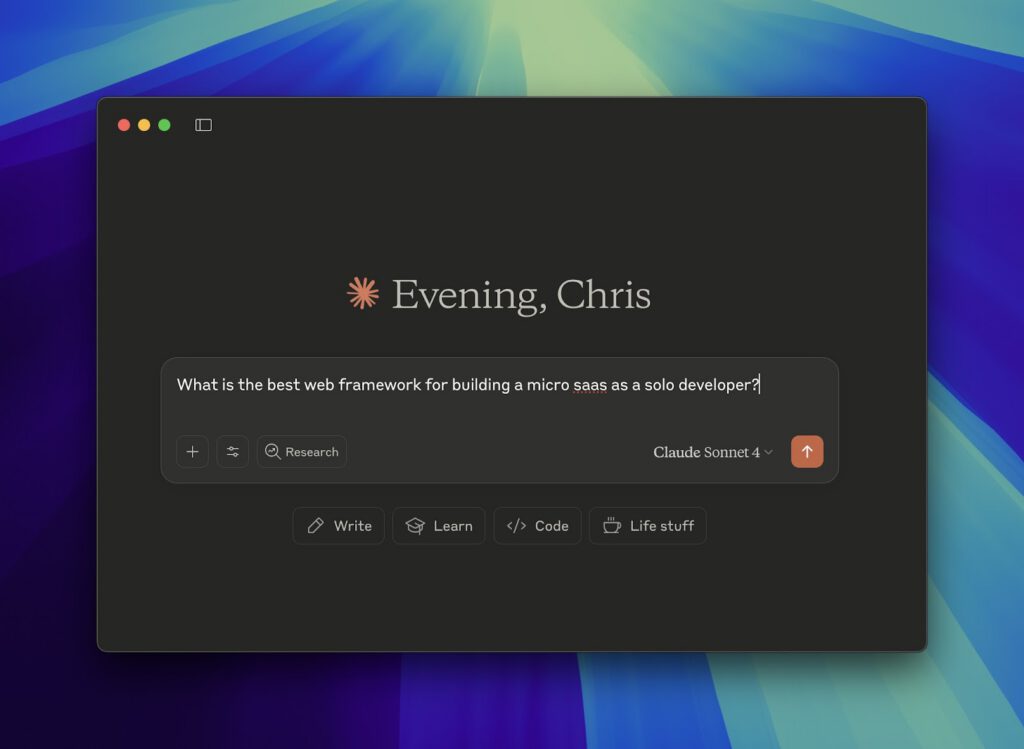
What I was looking for in a web framework
I’ve been building WordPress sites since 2012, growing a solid freelance business working with big creators on their personal websites. I’ve learned to keep things simple. I took this approach as a WordPress developer, and I believe it’s why most sites I built 5+ years ago are still kicking with no updates needed. When you keep it simple, tech debt is less likely to pop-up.
WordPress is great for content, but terrible for trying to build apps with. My first app is going to be a feedback tool (think emoji reactions to new features). Not that complex but I wanted to keep the same approach I had used for working with WordPress: Simple. Strong conventions. Minimal workarounds. Limited dependencies.
Another important aspect was finding a framework that the LLM’s knew well. I am a solo developer and in order to ship quickly I will be using AI to assist me.
The challenge? I’d been in the WordPress bubble so long I wasn’t sure what was out there. I knew Laravel and Next.js existed. Actually, those were the only two I was familiar with. But I wanted to find a framework to master so I could learn it deeply, create a starter template that I could use for each project, and move really fast.
When Claude told me Next.js was the way to go, I decided to jump in since I had already heard of it. It felt like as good of place to start as any.
My Quick Affair with Next.js
I installed Next.js and started building a basic app with auth and payments to get a feel for things. The plan was to use that as my starter and use this as an opportunity to learn a bit more about the framework. I instantly hit challenges.
Next.js has no strong conventions. You have options (which many devs love, but I hate). Since I was new to the framework, I was using AI to help explain things and get scaffolding in place. This matters because I leverage AI to write 90% of my code these days. I’m more of an architect, guiding AI through the logic and strategy. This lets me build what used to take teams of 10 developers a week in about an hour.
But here’s where it got messy. Every tiny feature needed a new package. We had multiple app file structures. The AI kept switching approaches because there were no conventions to follow. One day it put billing logic in /billing, the next in /lib/billing, then in /stripe. I constantly felt like I was doing it wrong and fighting an uphill battle.
This is when I found Tanstack Start.
Is beta enough?
I wanted to like Tanstack Start. It felt more organized than Next.js and had opinions about how things should work. I had found Tanstack Start when watching a YouTube video about Next.js. It appeared to be a more opinionated Next and simpler framework.
But it had two major problems. First, it was in beta. While I never hit bugs, development was moving fast and I was concerned about building on beta software.
The bigger issue? AI tools had very little training data on it, and what they had was outdated. The AI kept trying to force Next.js patterns and would suggest things like the Next Image component despite this not being a Next app.
For someone wanting to use AI tools to move faster, this wasn’t it.
Back to the Drawing Board
I went back to Claude. I explained how Next.js’s lack of conventions frustrated me, and how I liked Tanstack Start’s simpler approach but needed something AI tools knew really well.
Ruby on Rails, Laravel, and SvelteKit. Those were the three it recommended, with Rails at the top.
But I didn’t go for Rails yet. I decided to try SvelteKit first because I thought that Rails was old and dead.
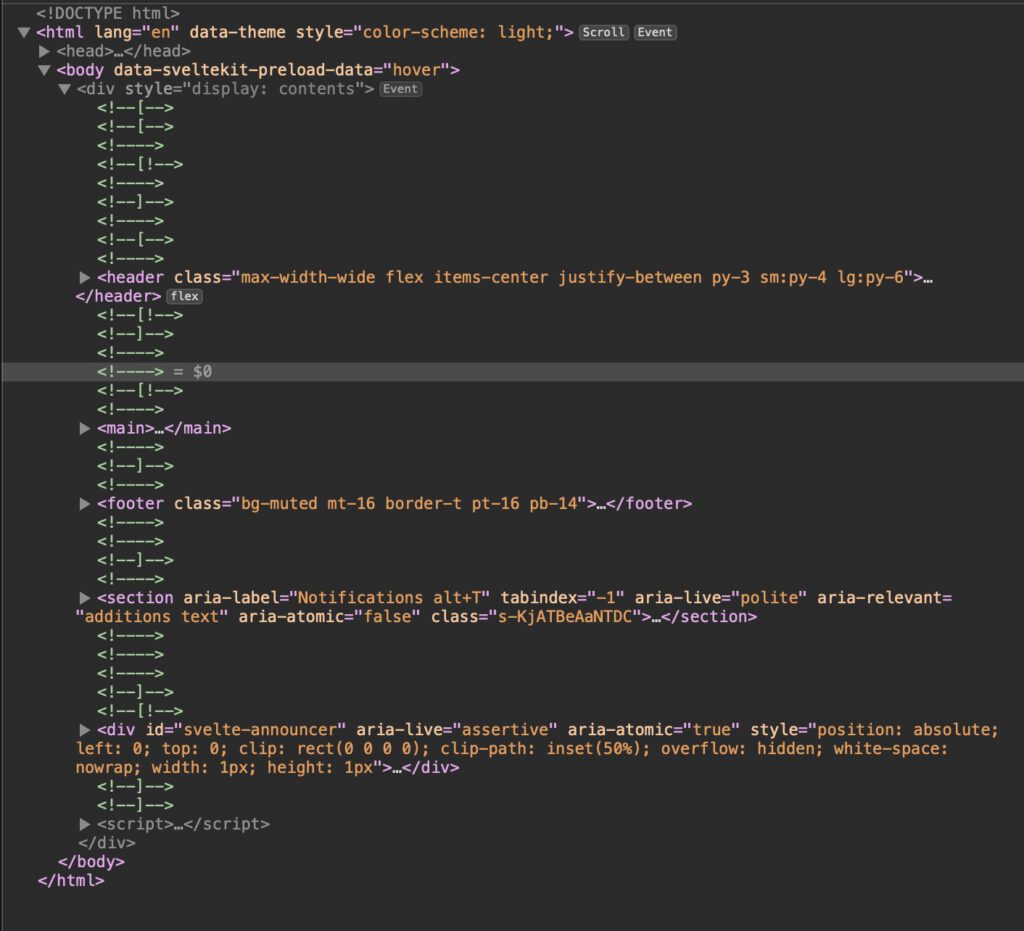
Comment fragments oh my! <!–[!–>
I started building a SvelteKit starter with auth and payments just like I did for Next and Tanstack Start.. It was going fine, but I had to hunt harder than necessary for information. I did like how simple it felt and that it had opinions about structure. It felt lighter than the previous two.
But I truly hated one thing: the comment fragments it left everywhere in the markup. <!–[!–><!–→ They’d be scattered throughout and bothered me every single time. I know it has no performance impact, but I like clean markup. Keep it simple.
Also, Svelte 5 had just come out with Runes, and the AI wasn’t great at writing code for these new patterns.
Plus, these JavaScript build processes for Next, Tanstack Start, and Svelte just felt weird to me. I learned web development by creating an HTML page with a CSS file. All this abstraction behind build processes felt unnecessary at the scale I was working on and the types of apps I wanted to build.
All roads lead to Rails?
Now that I’d tried all the modern JS frameworks, I went back to the list. Rails and Laravel were remained. I chose Rails with the honest thought that I would give it an hour and be going for Laravel (I already know PHP, so why not?)
After 15 minutes though, I was pretty sure I’d found home.
I’d never seen Rails code before, so I went through a YouTube tutorial. It instantly clicked.
The MVC conventions and generators blew my mind. I could have a working view with a form in just a minute. bin/rails generate gave you the bones instantly. Everything has its place, and it’s simply my job to shape it.
Rails has opinions, and I love it. Rails has way less line noise than any of the others. Rails felt readable. Rails felt fun.
Building with Rails
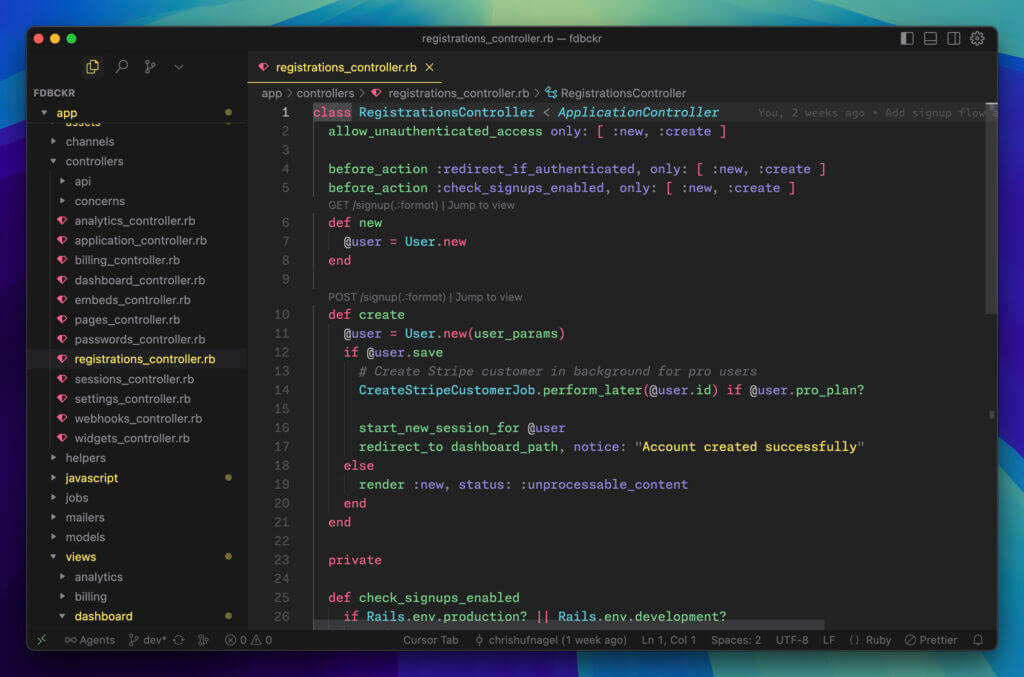
Coming from WordPress, exploring beyond the CMS territory was fascinating. Web apps felt simpler and more fun to work on. I only had to worry about specific functionality, not legacy content on a client’s 10-year-old site. Creating authentication from scratch was an enjoyable challenge. WordPress has this built in, so I’d never had to think about it.
The AI partnership was great too. Rails has been around for 20 years. Rails 8 is well-documented. There aren’t many ways to do things, so the AI often chose the same path I would.
Instead of worrying about which package to use or updating several packages before getting started, you get to focus on building. Rails puts everything into the developer experience and it truly shows.
As a solo developer leveraging AI to build apps, it felt wonderful. It might not work well for large teams. It might not be as easy to scale. It might not be as shiny and new as the others. But it works for me. I enjoy working with it. And if it’s good enough for Shopify, Github, and Basecamp; it’s good enough for me.
The lesson
Here’s what I learned: stop listening to what’s popular. Stop following the crowd. The “best” framework is the one that matches how your brain works and fits your specific needs as a developer.
For me, that’s Rails. For you, it might be something completely different. And that’s perfectly fine. Work towards finding what that is for you.
The only opinion that matters when building apps as a solo developer is yours.
 Get Nerd Notes
My wins, flops, & any XP earned.
No Spam. Exit anytime. See you there!